Drama is part of school life at LISA from the very first year, and it offers far more than putting on a play. Through games, exercises, rehearsals and performances, students discover what theatre can do, and they grow as people along the way.
Why drama?
In our drama classes, students learn the building blocks of theatre: how to give a scene meaning, how to improvise, and how to use different performance techniques. They also learn to work as a team. Along the way they get to let their creativity loose, whether that means designing a set, making costumes, or shaping a character. At LISA, students do not just bring a play to the stage. Drama offers so much more.
It also brings real benefits that reach well beyond the stage:
It is fun, and it builds confidence. Children love to perform. On stage they can be creative, show their personality, sing, dance and step into other roles. Slipping into a character also teaches them to see the world through someone else’s eyes, which builds empathy and an openness to different points of view.
It supports English. Because our students rehearse and perform in English, they pick up the language naturally, working alongside native speakers among both students and teachers.
It helps in every subject. Drama trains the voice, posture, and the ability to get a message across clearly. These are skills students use in presentations across all their subjects, and long after they leave school.
How the programme grows with students
Our drama programme develops as students move up through the school.
The first four years. In the early years, classes focus on the basics: voice, movement, and how to present yourself on stage. Students create stories and improvise every week, and they take part in at least two full productions. Teamwork is central, and we find these classes are a natural place to build mutual respect and tolerance. What each class does is flexible and shaped around the students themselves. A performance might be a scripted play, an original piece the class writes together, a radio play, mime, or a set of short scenes. Wherever we can, older students get involved in the younger classes’ productions, which builds friendships and a little mentoring across year levels.
The middle years. As students get older, the productions get bigger and the challenges more ambitious: more demanding roles, a wider range of acting styles, and the chance to take on leadership during a production. In the fifth and sixth years, students explore different approaches to acting and stage a full play, and they begin preparing to direct pieces of their own. They also learn how to audition, a skill that helps just as much with interviews and presentations as it does on stage. Step by step, students take on more responsibility, getting ready for the IB theatre programme.
The IB years. In the final years, the course follows the International Baccalaureate (IB) syllabus. Students take charge of productions themselves, directing and designing their own plays, and they put the theories and ideas from their IB courses into practice. Over the course of their IB studies, they complete a range of projects, including a research investigation, a piece of playwriting, a practical project (such as producing a play, making a costume, or designing the lighting), and a presentation.
On stage and behind the scenes
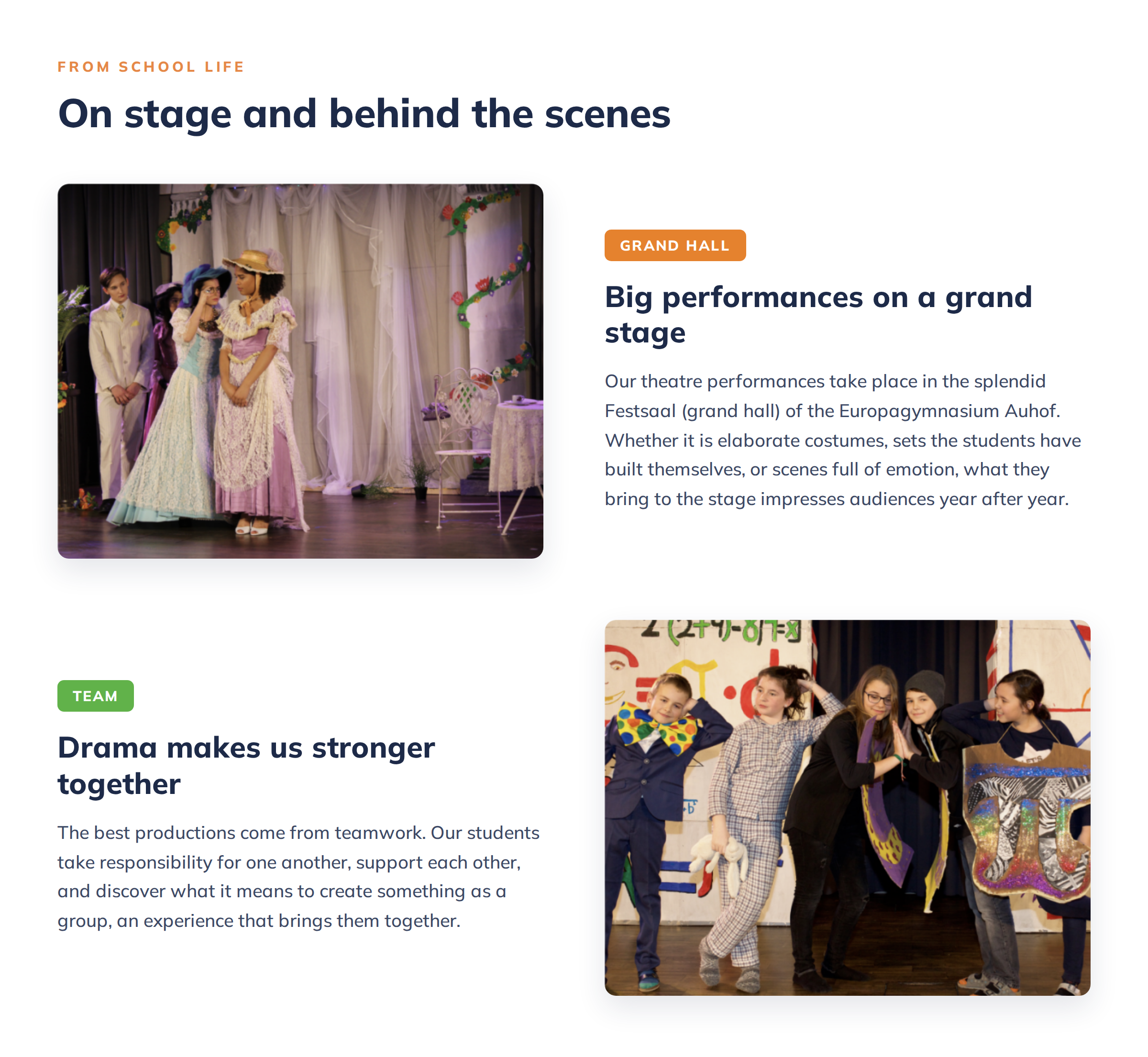
Our performances take place in the splendid Festsaal, the grand hall of the Europagymnasium Auhof. Whether it is elaborate costumes, sets the students have built themselves, or a scene full of emotion, what they bring to the stage impresses audiences year after year.
And the range is wide. Our repertoire runs from English-language performances to classic drama, and even to a play inspired by mathematics. It is as varied as our school community itself.
The best productions come from working together. Students take responsibility for one another, support each other through rehearsals, and discover what it feels like to create something as a group. That shared experience brings a class closer.
Our goal
In the end, our drama classes are about independence, both on stage and behind it. We want to open up the world of theatre for our students, and we hope they leave LISA with a love of it that lasts a lifetime.